



Imagine it’s back in November 2020: With the winner of the presidential election between Donald Trump and Joe Biden still uncertain, the Department of Justice (DOJ) writes to election officials in Michigan to request “all ballots (including absentee and provisional), ballot receipts, and ballot envelopes.” If local election officials don’t comply, DOJ threatens to go to court to get the records. What would have happened?
We avoided this question in 2020 — but only because DOJ refused Trump’s demands to seize election materials. There was no credible evidence of fraud, and partisan Trump loyalists had not fully consolidated control over the department.
Last week, more than five years after the 2020 election was certified, current DOJ officials delivered this exact request to election officials in Wayne County, home to Detroit.
And that’s a perfect illustration of why, when we look ahead to the 2026 election, we don’t expect it to play out just like 2020.
On the surface, the threat to the 2020 and 2026 elections looks similar: A would-be autocrat in the White House, facing the prospect of a sharp rebuke at the ballot box, laying the groundwork to try to overturn an unfavorable election.
But there’s a big difference between 2020 and 2026: This time, the entire apparatus of the federal government will be turned towards the goal of aiding Trump’s election interference. Even as the threat is more dangerous, though, we don’t need to let it succeed.
A fully weaponized executive branch
Although Trump was president in 2020, he hadn’t yet consolidated full control of the executive branch. As a result, in the 2020 election, the campaign to undermine and eventually overturn the result was run narrowly out of the White House, the president’s reelection campaign, and the Republican National Committee (RNC).
The core team was the president and a relatively small handful of acolytes, like Rudy Giuliani and Sidney Powell.
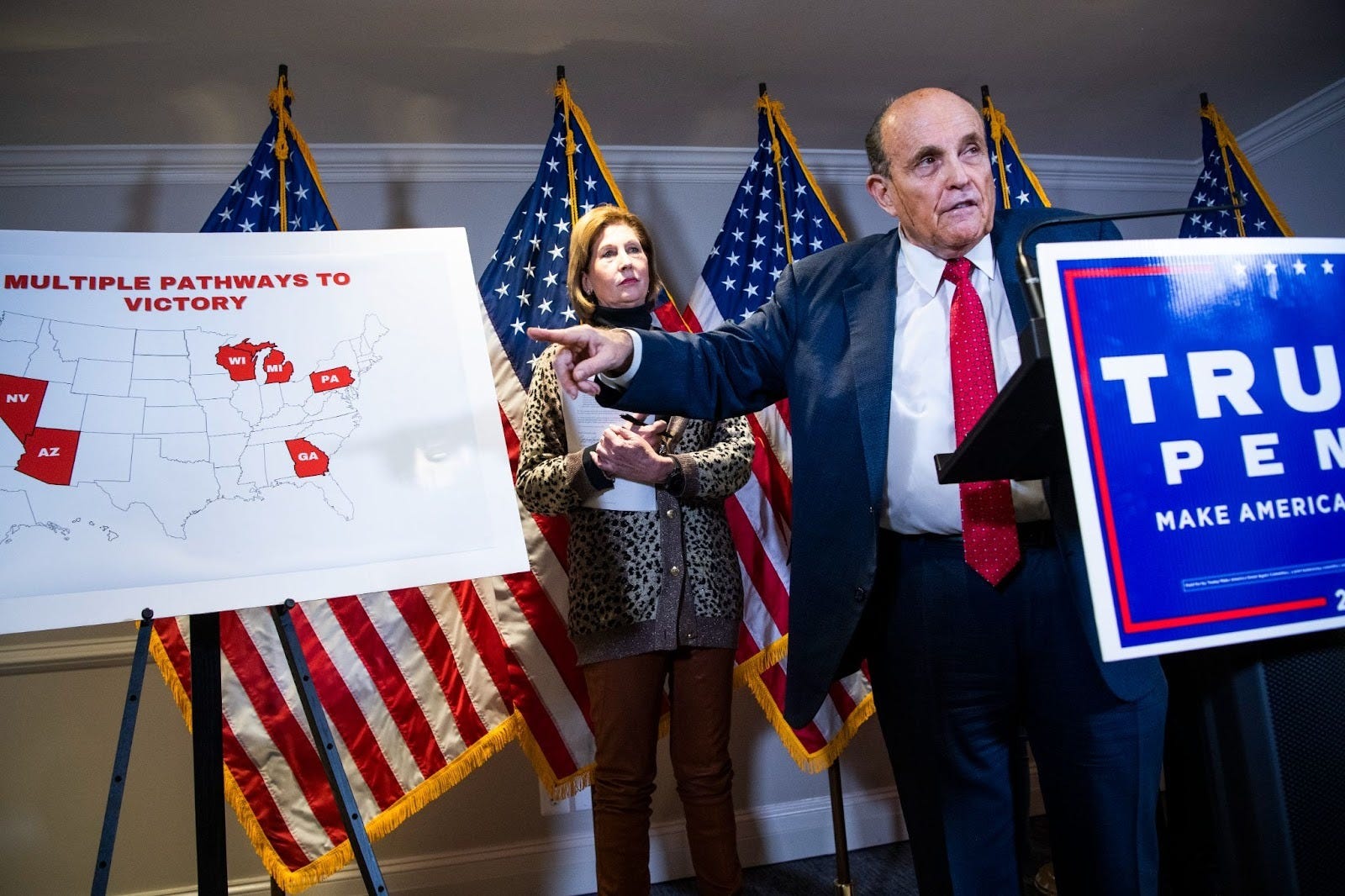
Not only did the rest of the federal government not participate in this attack on our democracy, but most of its critical functions continued working to follow the law and protect free and fair elections. The 2020 effort was attempted from inside the government and failed because of institutional resistance.
For instance:
The Department of Homeland Security, especially the Cybersecurity and Infrastructure Security Agency, CISA, was at the forefront of both cybersecurity and efforts to combat disinformation about the election.
The FBI worked closely with local election officials and law enforcement across the country to help secure the electoral process and respond to threats.
DOJ, famously, resisted the White House’s pressure to seize voting machines and worked in most cases to enforce the law and the Constitution.
2026 will be different.
As ProPublica documented in a crucial report this month, most of the people who worked within the federal government to protect the 2020 election are now gone, replaced with around two dozen election deniers. CISA has been gutted. Parts of the federal government that used to serve the public interest are now narrowly focused on protecting the president’s hold on power at all costs.
The Department of Justice is Exhibit A in the transformation of the federal government. In the weeks since Attorney General (AG) Pam Bondi’s firing, we’ve seen DOJ officials engage in an Apprentice-style competition to be Trump’s AG (with Acting AG Todd Blanche and Harmeet Dillon, assistant attorney general for civil rights, in starring roles) and make desperate moves just to hang onto their jobs (FBI Director Kash Patel). Over the past week:
Dhillon has doubled down on illegal and unprecedented demands that states turn over their confidential voter data (more on that later);
Blanche has declared that Trump has a “right” to prosecute his enemies, while allowing Trump’s former personal attorney Joseph DeGenova to take a leading role in a purported prosecution of former CIA director John Brennan; and
Patel has promised new “evidence” that the 2020 election was rigged.
That’s why I expect nearly every available lever of executive power will be deployed as part of this campaign to deceive the electorate about the security of their elections, to disrupt the electoral process, and to deny the results.
The groundwork is already being laid for this whole-of-government election subversion strategy.
Seizing voter data: A case study in weaponized government
How does control of government translate into election subversion? The administration’s dangerous and illegal effort to gain access to states’ confidential voter rolls offers a case study.
Let’s start with a refresher on how elections should work: In the U.S., states — not the federal government — are responsible for running elections. They register voters, maintain voter lists, and have processes for verifying the eligibility of every voter. Over the years, in order to promote the right to vote, Congress has taken steps to ensure that states maintain accurate voter rolls and certain uniform standards for voting eligibility. However, Congress has never authorized the federal government to take over responsibility for vetting voter rolls. And, although the Constitution gives Congress the power to make laws involving election administration, under our Constitution and laws, the president has zero role in state election administration — including voter registration.
Despite this, heeding the president’s command to “nationalize elections,” the DOJ Civil Rights Division has contacted nearly every state and the District of Columbia over the past year to demand their complete voter files, which are filled with sensitive personal information for every voter, such as Social Security numbers, driver’s license numbers, and political party affiliation. During the same period, DOGE worked (unlawfully) to integrate Social Security data into an existing Department of Homeland Security (DHS) database used by a handful of states to check voters’ citizenship status.
The Trump Administration says they want all this data to stop ineligible voters from registering and casting a ballot. But election fraud of any type is extremely rare, in no small part because states already have checks in place to ensure that only eligible voters register, and state and federal laws (including immigration law) impose heavy penalties for illegal voting.
So what is the data grab really about? As my colleagues Izzy Gray and Sara Chimene-Weiss explained earlier this year:
There’s a common phrase in the research world: “If you torture the data long enough, it will confess to anything.” In short, with enough manipulation, you can make a dataset say whatever you like.
This is exactly what the Trump administration wants to do: accumulate enough voter data that it can torture this data into confessing the predetermined conclusion that, should the president’s preferred candidates lose, it will have been because of fraudulent votes from ineligible voters.
They will do this by mixing and matching the states’ voter data to other federal databases, including the expanded SAVE database, in ways that are almost certain to result in false allegations of voter fraud. For example, they will try to match the state voter data to names of alleged noncitizens in the inherently flawed SAVE database. But we know that SAVE data is often out-of-date — for instance, continuing to identify Americans as non-citizens long after they have obtained their citizenship.
But even false voter fraud allegations will serve the administration’s purposes: baselessly creating doubt and confusion about election security; disenfranchising eligible voters; and creating a false narrative to justify further election power grabs. Each lays the groundwork in service of their ultimate goal: to prevent or overturn the results of future elections that do not go the administration’s way.
The good news? Most states didn’t go along with this scheme: Only 12 states voluntarily complied with DOJ’s request for voter data.
That’s when the federal government turned the heat up on this effort. In January, at the height of Operation Metro Surge in Minneapolis, then-AG Bondi attempted to leverage the violence being wrought by DHS agents to blackmail Minnesota officials into turning over their voter rolls. That effort was also unsuccessful — Minnesota Secretary of State Steve Simon stood strong.
But DOJ isn’t backing down — to date, DOJ has sued a total of 30 states in a quest to force them to hand over confidential voter information.
How we can resist an elections takeover attempt
I don’t say any of this to be alarmist: Even though President Trump has consolidated power in the executive branch to an unprecedented extent, the institutions of our election system can survive this assault. But it will require all of us to take action to defend them.
The ongoing efforts to thwart DOJ’s voter-data crusade illustrates how it can be done.
First, we all — including the news media — need to tell the truth about what the administration is doing. There is no meaningful amount of fraud in our electoral system, and the voter-data grabs aren’t a serious attempt to find it. Instead, the true purpose is to confuse voters about the trustworthiness of our electoral system, kick eligible voters off the rolls, and cast doubt on election results that don’t go the administration’s way.
Second, officials need to stand up to the federal government and provide the checks and balances the framers intended. The bipartisan resistance to voter-data grabs is a model: In addition to uniform resistance from Democratic leaders, red-state officials like Utah Lt. Gov. Deirdre Henderson have vocally objected to the administration’s efforts to insert themselves into state election processes. And career civil servants who specialize in privacy-protection have resigned from government over this and other data grabs.
Third, voters need to stand up for their own rights when state officials fall down on the job. That’s why five voters from states that turned over their data to DOJ, along with Common Cause, filed suit this week to stop and undo DOJ’s efforts to create a national voter database. Plaintiffs — represented by my colleagues at Protect Democracy, along with our co-counsel at Citizens for Responsible Ethics in Washington, the American Civil Liberties Union and its DC affiliate, and Harvard’s Democracy and Rule of Law Clinic — lay out a compelling claim that our Constitutional delegation of powers over elections, as well as laws protecting individual privacy (among other provisions), bar DOJ from creating a national voter registration database.
Fourth, courts must hold the line against federal intrusion into state elections. So far, they are doing so — all of the five district courts that have ruled so far have held that the federal government lacked the right to confidential voter data.
That’s a lot of work, by a lot of people, to fend off just one of the ways the administration is weaponizing the federal government against our elections. Over the coming weeks, we’re going to dive deep into every aspect of the threat — and then, more importantly, get into how you can help. Because while it’s true that the threats aimed at our elections are greater than they’ve ever been, together we can and will prevent them from succeeding.
This is part two in our Executive Override series on threats to the 2026 election and how to combat them. You can see all editions in this series here. If you’re not subscribed, make sure to do so to get future editions in your inbox.
The investigation into Fed Chair Jerome Powell hits a dead end
The Department of Justice announced that it was dropping its investigation into Federal Reserve Chair Jerome Powell, privately acknowledging that they had no evidence Powell committed any crimes. This news comes as President Trump’s nominee, former Fed governor Kevin Warsh, vowed that monetary policy would remain “strictly independent” and that Trump never asked him to pre-commit to lower rates during his confirmation hearing. Dropping this investigation clears the way for Warsh to be confirmed as the new chair.
Because of Warsh’s nomination, though, democracy advocates should continue to monitor the independence of the Fed in the months to come. The Iran war has driven energy prices higher, pushing inflation to its fastest pace in nearly two years, which only makes the independence of the Fed more important.
See the Authoritarian Action Watch.

The main vulnerability of the midterms and future elections is the election software. Trump supporters own the two companies that make voting equipment and write the election software that scans, records and tabulates our votes. A Trump supporter owns the company that certifies that the election software and any updates work properly. Trump dominates the Election Assistance Commission that oversees the entire process and has gutted its technical committee that oversees the software. While security protocols are supposed to make sure the voting equipment and installed software is working properly and risk-limiting audits after votes have been cast and counted are supposed to identify any abnormalities, they are woefully inadequate. There has been enormous attention paid to block Trump's well-publicized attempts to suppress the vote, but almost no attention to the real chance he will manipulate the vote count. Election Truth Alliance conducted extensive analysis of the 2024 presidential election and uncovered numerous statistical anomalies indicating there were problems in the vote counts that led to Trump's improbable wins in all swing states. Since the introduction of computers into our voting system, we can no longer assume that just because our elections are locally managed, that makes them too distributed to manipulate. The election software is what is called in the analysis of airplane crashes as "a single point of failure," the one component that if it fails brings down the entire aircraft.